

Steps

The word “step” in family terms has a surprisingly old and layered history. It comes from Old English, where steop- meant “bereaved” or “orphaned,” someone who had lost a parent. By the Middle Ages, “stepmother,” “stepfather,” and “stepchild” were in use to describe the new family members who arrived most often after a death, since divorce and remarriage was rare in those days. Even then, the term carried a subtle sense of being outside or apart, of replacing someone who was gone.
That meaning hasn’t entirely disappeared. Every “step” relationship I’ve had from stepmom, to stepdads, to stepsiblings, to stepgrandparents and so on has carried a faint echo of that old word, that the spot was always a little borrowed, a little provisional. And yet, the word itself is neutral. It simply describes a connection by marriage, not by blood, but for someone living it, that clinical label can feel like a lifetime of reminders.
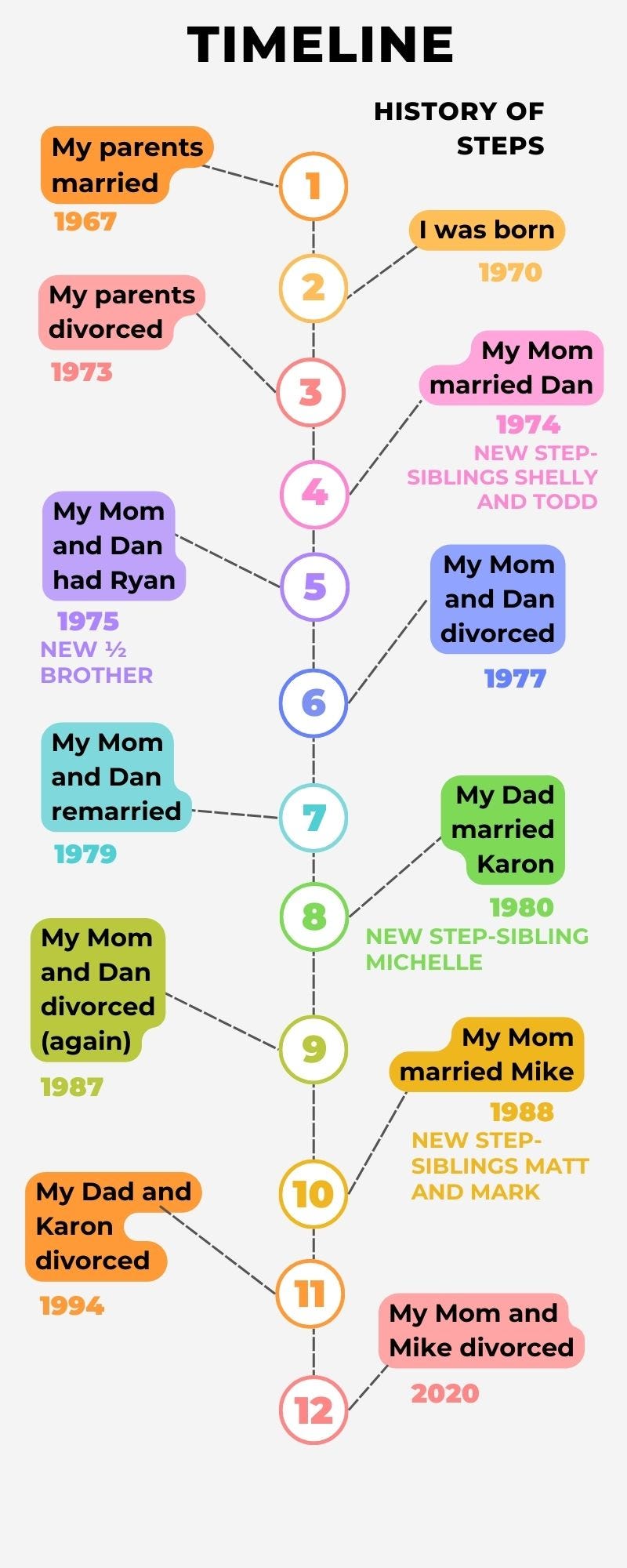
Growing up, I collected steprelatives like some kids collect stamps, but unlike stamps, I never chose them.
The first time my mom remarried, I was about three or four years old, and I suddenly had a stepdad and stepsiblings. I didn’t really understand what was happening, but I knew the man we were now living with was obviously not my dad, and I had a strong sense that things were off kilter.
I can’t speak for my then new stepsiblings, but I imagine they might have felt similar. Maybe, like me, they felt like outsiders in what was supposed to be their own family. I know I did, especially once my little brother Ryan was born, and the three of them - my mom, my stepdad Dan, and Ryan - became a family unit.
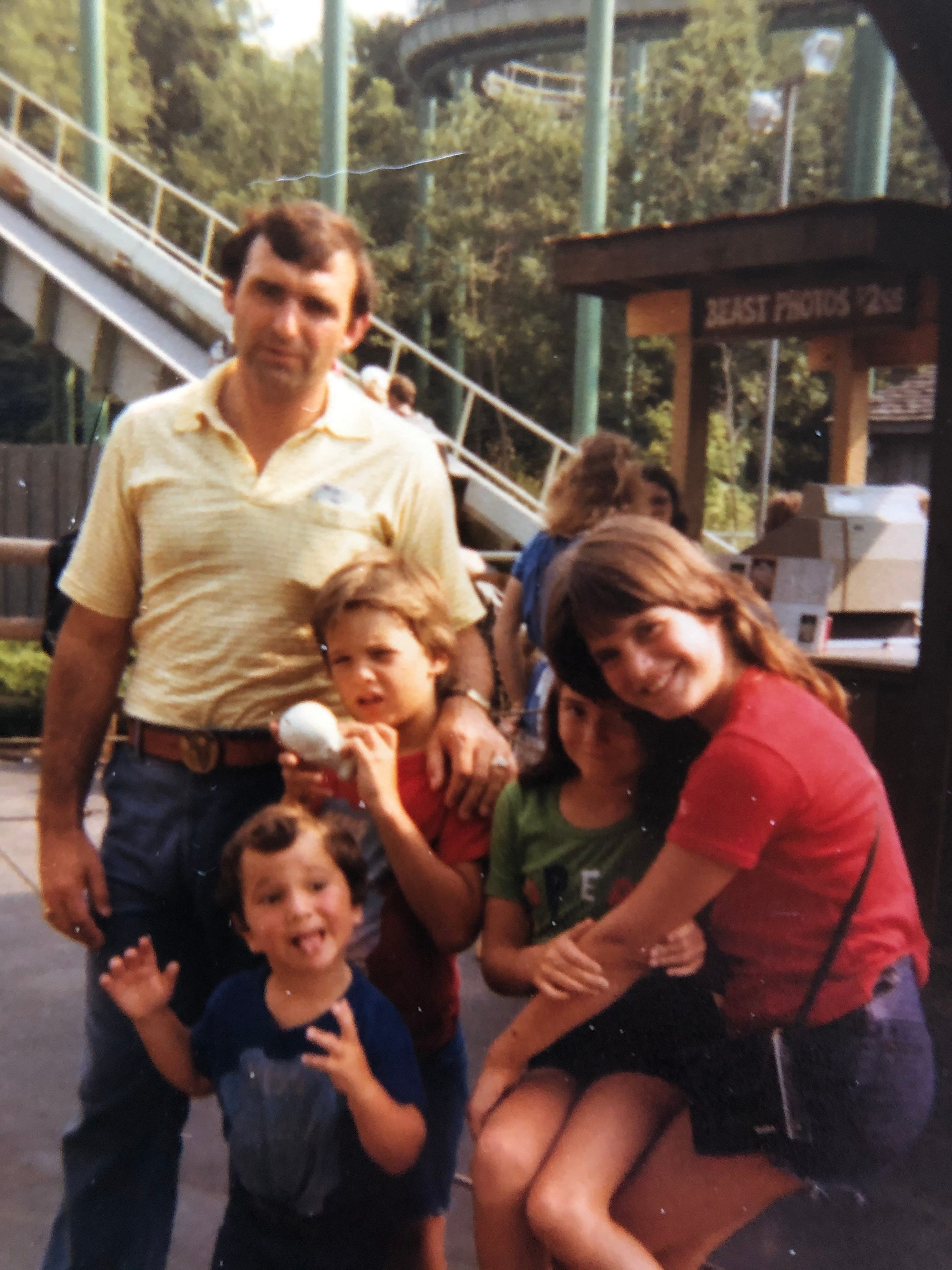
📸Me with my first stepdad Dan, his two kids Shelly and Todd (my new stepsiblings), and my brother Ryan
My mom remarried a total of three times, adding two stepdads, more stepsiblings, and an extended network of stepgrandparents, stepaunts, stepuncles, stepcousins, and ex(insert step relation here) everytime there was a divorce. Every new wedding meant another set of rules, another set of expectations, another household where I seemed to be the outsider. It wasn’t just about missing a biological connection, it was the relentlessness of it, the fragility, the uncertainty, the not knowing how we all fit. It felt like the way you try to shove a puzzle piece into a space where it does not belong.
My dad remarried when I was ten, and with that, the weekends when it was just the two of us were over. My new stepmom brought her daughter, and once again I found myself as the outsider, visiting their home, where the three of them were a consistent unit and I was the visitor.
My parent’s generation, the Baby Boomers, divorced and remarried with startling frequency, often without ever pausing to consider the consequences for the kids left in the wake. Marriage, for them, seemed almost disposable, basically believing that if it didn’t work, move on. If it did, layer in a new family, a new household, a new set of relational dynamics.
Part of what made it all so bewildering was that my parents had no idea how this constant churn of “steps” affected me. How could they? Their own parents had stayed married, where they experienced stable households, parents living together as lifelong partners, family trees that grew in predictable directions. They had no frame of reference for what it meant to shuttle between homes, or perform belonging in spaces where you didn’t truly belong. And when I failed at that performance, I got in trouble. If I wasn’t smiling enough, I was lectured on my “disposition.” If I wasn’t saying or doing the right thing for my stepparent, I was talked to again.
The marriages might fail, but the children were expected to adapt, to accept, to participate, as if family were a game of musical chairs with no chance to sit still. It was exhausting, and it left me with a strange mix of bewilderment and resignation. I didn’t just have steprelatives, I had a social experiment unfolding around me, one I had no say in, one that seemed oblivious to its own consequences.
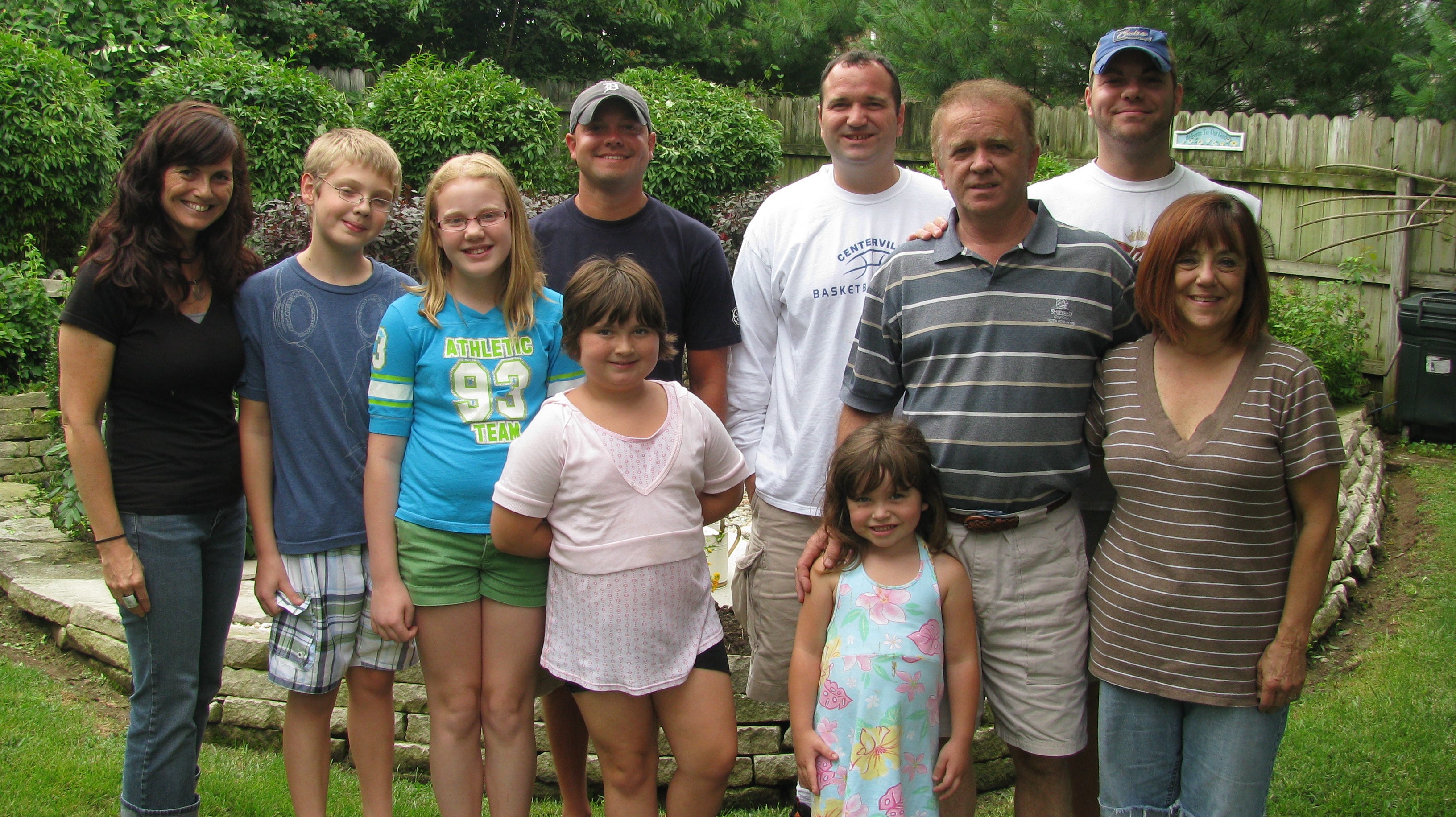
📸Another family of steps (including a stepdad, stepbrothers, and stepniece and stepnephew) that is no longer
I don’t think they were cruel, I think they were careless. They were moving through their own heartbreaks, their own new beginnings, without pausing to imagine what it meant for a child to inherit all those extra layers. For them, remarriage was a chance at happiness, a chance to start again. For me, it was another monumental shift, another stepfamily to absorb, another place to feel like it wasn’t home.
Both things are true.
Looking back now, I can see that this endless layering of steps created an acute awareness of impermanence. Nothing was stable. Every connection could vanish, every bond was contingent on circumstances outside my control, every household could dissolve or reorganize at any moment. And yet, at the time, there was no language for it, no way to articulate that what felt like rejection was really just a symptom of a generational pattern.
The truth about step relationships is that many of them don’t last. When the marriage ends, so does the family tree that came with it. A stepmom disappears, a stepdad drifts away, stepsiblings fade into their own lives. Sometimes it happens abruptly, sometimes gradually, but the result is the same. People who were once called “family” vanish without ceremony. There are no farewell parties for stepgrandparents, no rituals for saying goodbye to a stepsister you’ll never see again. You just never see her again.
When I was younger, that dissolving felt strange, like waking up from a dream where entire households no longer existed. At times, it was a relief. The weight of forced connection suddenly lifted. At other times, it felt hollow. All that effort, all those years of obligatory holidays and invested time and energy, erased in an instant.
All of this has shaped how I understand family now. Not as something automatic or guaranteed, but as something revealed over time. I no longer believe that proximity, paperwork, or shared last names make a family. What matters is consistency. Choice. The people who stay when they don’t have to.
Growing up with so many step relationships taught me early that connection can be temporary, and that belonging can’t be forced. It also taught me to be intentional. I pay attention to who shows up, who listens, who makes space. Those are the relationships I honor now, not because I’m obligated, but because they are real.
This isn’t a story about victimhood. It’s a story about formation. About how a childhood full of shifting households and dissolving families taught me to value consistency and chosen connection. We are all a sum of our experiences, and this is one of mine. Not something I carry as a wound, but as a map, one that shows me exactly where I stand, and who I stand with, now.
Love this!